About EWR
The EWR Advantage
History
EWR Radar Systems, Inc. has been a leader in weather radar innovation since 1982. The Quality Management System (QMS) of EWR is ISO 9001:2015 certified, and the company is dedicated to maintaining the highest levels of operational availability in the most demanding military and commercial environments. With decades of experience advancing radar technology, EWR combines a proven heritage in weather radar development with a commitment to delivering state-of-the-art products and services that address the evolving needs of customers worldwide. This dedication to innovation, reliability, and performance has established EWR as a trusted leader and the gold standard in weather radar.
Headquartered in Saint Louis, Missouri, USA, EWR provides weather radar products and services to a diverse range of clients, including multiple branches of the United States Department of Defense, NATO alliance members, international militaries, international airports, utility companies, oil companies, municipalities, first-alert responders, and more.
EWR offers many different products and services specifically designed to conform to the end-user’s unique radar performance requirements and technical specifications. EWR systems combine state-of-the-art solid-state transmitters, pulse compression and Advanced Single Pulse (ASP) technology with innovative, proven design to provide safety, accuracy and reliability. EWR’s field-proven, full turnkey weather radar solutions are designed to minimize relative footprint and environmental impact of similar technology. EWR’s product offerings are all Commercial Off the Shelf (COTS) items; however, EWR has the capability and experience to fine-tune weather radar systems to meet the specific needs of the end-user and the application.
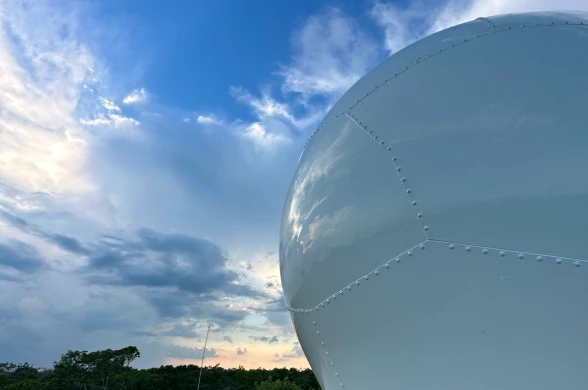
In 2006, EWR released the revolutionary solid state E700 PDR system, creating a new category of portable Doppler weather radars. This ground breaking modular concept was designed for field use by military personnel – and was quickly adapted by the U.S. Marine Corps and the U.S. Air Force. The E700 PDR radar consists of three primary modules: a radome unit which contains all of the RF components, digital transceiver, and the antenna assembly; a radar processor enclosure; and a pneumatic mast. The radome unit was specifically designed to be mounted on the easily deployable pneumatic mast, which can raise to radar to a height of up to 50 feet. The modular architecture allows for easy field set-up and tear-down, and quick field replacement of components, which is critical to a highly dynamic field deployment. The E700 PDR can be unpacked, set-up, and operational within 30 minutes. A number of standard mounting options exist, which allow the user to mount the radar on top of a roof or building, or attach the mast to a mobile trailer or platform. The key enabling technology for this rugged, reliable, and highly portable radar system is the use of a solid state transmitter.
EWR’s weather radar systems provide clients with a comprehensive view of the operational environment, enabling optimal situational awareness. Our radars deliver critical surveillance information by detecting and interrogating weather phenomena, then generating, displaying, storing, and distributing actionable weather products through our user-friendly WeatherScout® software. This integrated solution empowers key decision-makers to plan, prepare, mitigate risk, and adapt with confidence in changing weather conditions.
Solid-State Advantage
Magnetrons are generally the lowest cost transmitter solution, particularly at higher frequencies such as X-band. However, the transient oscillation nature of a magnetron results in random phase operation. Pulses from a magnetron are not coherent and require the radar to use “coherent-on-receive” processing, which limits the clutter cancellation ability of the radar and limits some advanced phase-based algorithms for multi-trip echo correction, for example. Fully-coherent radars, such as those using solid-state or klystron transmitters generally have better clutter filtering capability and allow for more varied waveform selection (such as pulse compression waveforms) and pulse repetition interval selection. Moreover, solid-state amplifiers generally can switch pulse widths, frequency, and pulse repetition intervals at a pulse-by-pulse basis.
Magnetron transmitters are generally not frequency agile. Thus, the transmit frequency cannot be easily changed like in a solid-state radar. This can be problematic for mobile radars that may need to avoid particular frequencies for local interference issues. Klystrons allow for some frequency-variability, but are generally narrowband due to the device physics, whereas solid-state amplifiers at X-band may have an operating bandwidth in the hundreds of MHz.
In many weather radar applications portability and ruggedness are key driving factors in the selection of a system. The elimination of tube amplifiers greatly enhances the reliability of the radar, particularly during rough transport, and allows the radar to be operated immediately upon a cold start. In addition, the lifespan of a solid-state transmitter is generally much longer than for a magnetron based transmitter, where the magnetron may need to be replaced after just a few years of operation.
The high voltages required in tube-based radars may also be a concern for many users, particularly those that may need to service their systems in the field.
Pulse Compressed Waveforms
Pulse compressed waveforms amplified by a solid-state transmitter can provide sensitivity comparable to much higher power tube-based transmitters. For example, a 1 kilowatt solid state transmitter producing a 50us pulse compressed waveform with a 1 MHz bandwidth has the same sensitivity and range resolution as a 1us pulse transmitted by a 50 kilowatt tube-amplifier. By using solid state amplifiers, peak power is traded for average power with no loss in system performance. In an EWR radar, the pulse compressed waveform’s inherent “blind-range” is mitigated using Advanced Single Pulse (ASP) technology.
Solid State Value
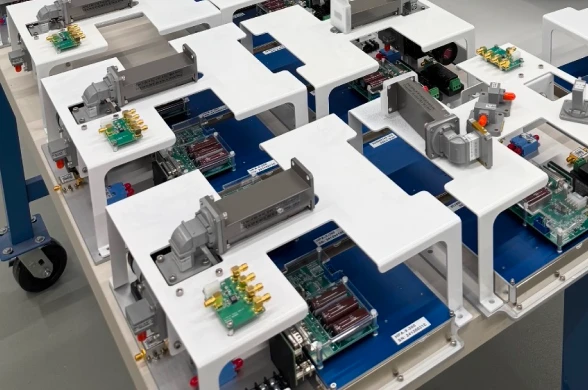
Historically, the higher cost of the solid state amplifier has been a driving factor when specifying a radar system. Decades ago, the cost per watt of solid-state amplifiers made them prohibitive for use in many commercial applications, particularly at higher frequencies such as X-band and C-band. However, over the past several years, the rise of Gallium Nitride (GaN) transistor development for the telecom and defense industries have driven the cost per watt down significantly. Even microwave ovens, once the most significant user of low-cost magnetrons, are beginning to incorporate solid-state amplifiers to leverage the transistors ability to vary frequency and amplitude. Commercial aviation and marine radars, which have similar performance and reliability needs as portable weather radars, are beginning to transition to all solid-state RF sections.
A New Generation of Radars
The latest generation of EWR radars includes the dual-polarization E800LP radar. It is a cost-effective system designed for users who need more detailed and accurate radar information without the size, complexity, and infrastructure costs of a larger radar.
Because of its compact size and low installation requirements, the E800LP is well suited for mobile applications, filling gaps in existing radar networks, and permanent locations where installing a larger radar system may be difficult.
The E800LP can operate in two different polarization modes, giving users access to a wider range of weather measurements. This flexibility allows the radar to be configured for different applications and operating needs.
Unlike traditional tube-based radars, the E800LP does not require expensive and bulky equipment to switch between polarization modes. Instead, each polarization channel can be controlled independently. This gives users the flexibility to customize how the radar operates, including its scanning patterns and measurement settings, to best meet the needs of each specific application.